
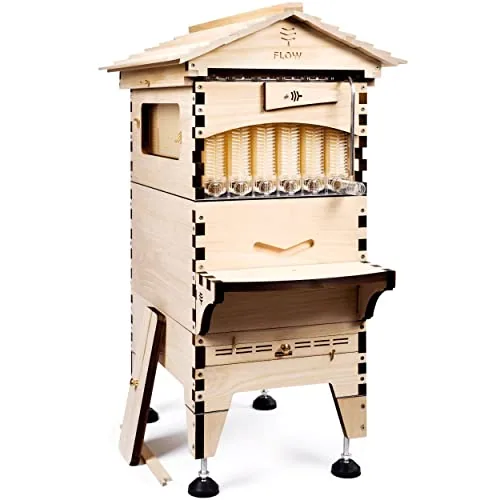
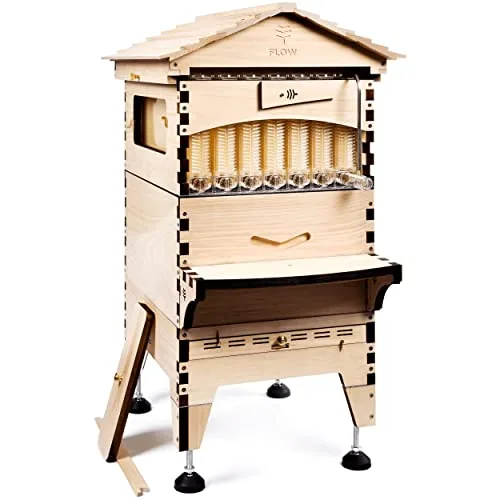
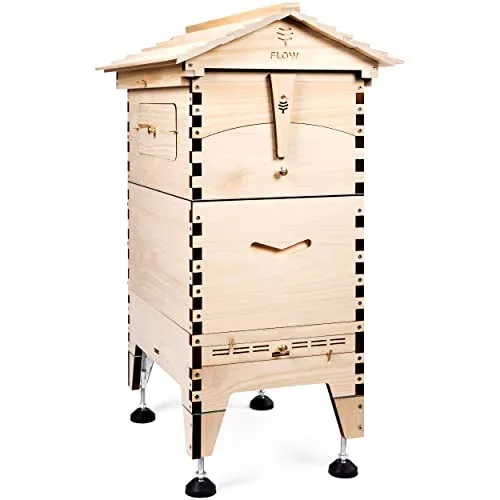
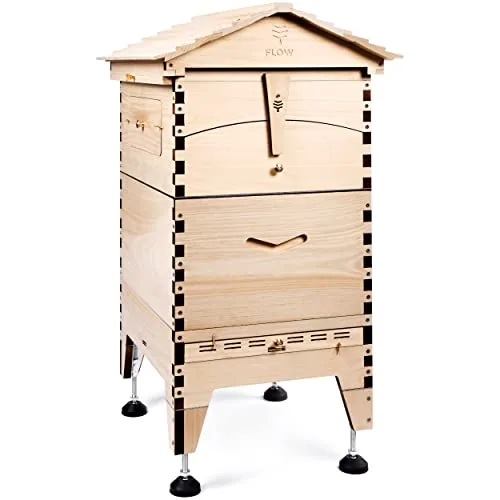
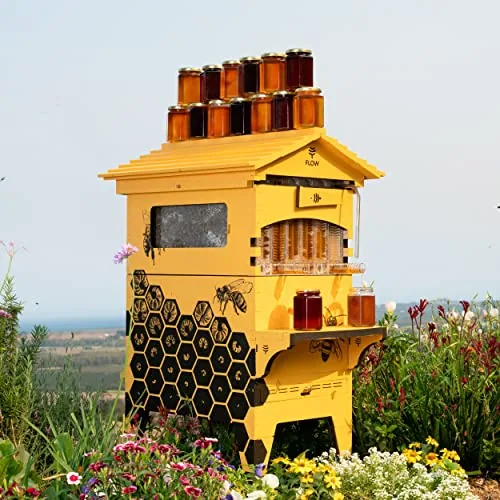
- The official listing ships the Flow Hive 2 with 6 Flow Frames, a multifunction tray, an adjustable stand and a harvesting shelf (model 108-L-AMA-06).
- Flow says each full Flow Frame gives about 6.5 lb (3 kg) of honey, so a full 6-frame super is about 39 lb.
- The brood box matches an 8-frame Langstroth deep, so you still inspect, feed and treat for mites like any Langstroth beekeeper.
This Flow Hive 2 review covers the official listing only: what it includes, how the tap-harvest frames work, where the hive makes life easier and where it does not. It is built from the listing, Flow's support pages and extension guidance, not from a colony of our own.
If you are still deciding on a hive style, read Flow Hive vs Langstroth first, or start with our best beehive for beginners list. Bees are not part of any hive kit: you buy a package or nuc from a local or regional supplier.
Who it’s for, and who should skip it
- want to harvest honey at the hive without buying or renting an extractor
- keep one or two hives in a backyard and like the idea of jarring honey straight from a tube
- will manage the brood box like any 8-frame Langstroth, with inspections and mite counts
- value an official product with Flow's warranty and support over a cheaper look-alike
- want one hive style that also gives you comb honey, wax and spare drawn comb for splits
- live where honey often crystallizes in the comb, since crystallized honey will not drain from a tap-style frame
- already run 10-frame equipment and want every box in the apiary to swap
- expect a hive that needs less inspection or mite control than a standard Langstroth
Pros and cons
- Official listing with 6 Flow Frames in the super and model number 108-L-AMA-06
- Harvest without uncapping, spinning or straining for most of the crop
- Multifunction tray, adjustable stand and harvesting shelf are included per the listing
- Brood box matches 8-frame Langstroth deep dimensions, per Flow
- The listing gives few specs: timber, assembly state and brood-frame contents are not listed
- No beeswax harvest from the Flow super, and no comb honey
- Crystallized honey in the cells will not drain
- Does not reduce inspections, swarm management or varroa control
- Look-alike kits make buying the wrong one easy
Specs
| Frames | 6 Flow Frames in super |
|---|---|
| Includes | Multifunction tray, adjustable stand, harvest shelf |
| Model | 108-L-AMA-06 |
As stated by the maker or seller; confirm on the listing before you buy.
What is in the Flow Hive 2 listing?
The official listing is short: six Flow Frames, a multifunctional tray, an adjustable stand and a harvesting shelf, with a claim of "up to 40 lbs of honey when super is full". Its line that the hive "works in all climates" is a maker claim.
Flow Hive 2: what each source says
| Item | Official listing | Flow support and forum |
|---|---|---|
| Flow Frames | 6 Flow Frames | 6 in the super (staff reply) |
| Brood box | Not listed | 8 wooden frames, same dimensions as an 8-frame Langstroth deep |
| Honey per full super | Up to 40 lb | About 39 lb (6 × 6.5 lb) |
| Stand and tray | Adjustable stand, multifunction tray, harvesting shelf | — |
| Timber and finish | Not listed | Check with Flow before you order |
| Model number | 108-L-AMA-06 | — |
Source: Official listing; Flow support and Flow forum
The listing leaves out the timber, assembly state and brood-frame contents, so ask Flow if those matter to you. The Flow Hive Classic listing has even less detail.
Flow Hive 2, 6 Flow Frames
- Frames
- 6 Flow Frames in super
- Includes
- Multifunction tray, adjustable stand, harvest shelf
Best for Tap-harvest honey in a backyard
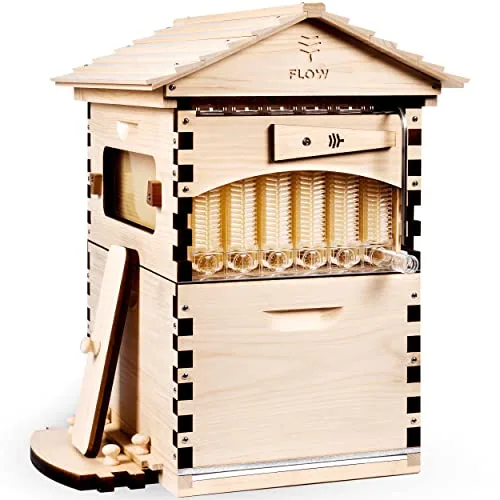
Flow Hive Classic, 6 Flow Frames
- Frames
- 6 Flow Frames
Best for Flow harvesting on a simpler hive
How does harvesting from a Flow Frame work?
Flow Frames are plastic honeycomb that bees finish with wax, fill and cap. When a frame is full, you turn a key; Flow describes this as splitting the cells so honey runs to a channel at the bottom and out through a tube into your jar. Reset the key and the bees repair the cells and refill them.
Flow itself warns that yield depends on hive strength, climate and forage, varies year to year, and that you must leave enough honey for winter. A strong flow can fill the super more than once; a poor year may fill none of it.
Harvest capped honey only
Uncapped nectar can be too wet and may ferment, so harvest frames the bees have capped. If you plan to sell, a refractometer from the honey harvest category lets you check moisture, and the USDA grade standards give the reference limits. The honey yield calculator turns pounds into jars once you know roughly what to expect.
Is the Flow Hive 2 good for beginners?
It can be, if you accept what the Flow super does not change. The brood box is a standard 8-frame Langstroth deep, so your first year is the same as any Langstroth beekeeper's: install bees, feed if needed, inspect every week or two, watch for swarm signs and count mites.
- Varroa still decides whether the colony survives. Sample about 300 bees and compare the count with the HBHC 9th-edition thresholds in the mite threshold calculator. Treat only with an EPA-registered product, used exactly per its label, and never with the honey super on unless the label allows it.
- You still need protective gear and tools. A veil or suit, gloves, a smoker and a hive tool are part of every inspection. See our best beekeeping suits if you need one.
- First-year honey is not guaranteed. A new colony often needs its stores for winter, which Flow also tells owners to leave in place.
- The 8-frame size is lighter to lift, but any extra boxes must be 8-frame too.
The how to start beekeeping guide covers the first-year timeline; the first-hive shopping list lists the rest of the gear. For frame-count trade-offs, see 8-frame vs 10-frame.
How to tell an official Flow Hive listing from a knockoff
Flow says it finds counterfeits on online marketplaces, some reusing Flow's own images, videos and logo. Our catalogue research found more than a dozen flow-style kits that are not Flow products. None are linked on this site.
- The title says "Auto flow", "Automatic flow beehive", "Self-Flow", "Flow-style", "Flow honey beehive" or "Upgraded Flow Hive" instead of the plain product name. Flow lists several of these names as ones counterfeiters use.
- The brand line or store link names a company other than Flow.
- Odd frame counts and bundles, such as 4 or 7 "honeycomb trays" with 6 brood frames, a stand and an observation window, at a fraction of the usual cost.
- Two ventilation holes in the roof, which Flow says genuine Flow Hives do not have.
Five checks before you order
- Match the product name and model. The official Flow Hive 2 listing is titled simply "Flow Hive 2" and lists part number 108-L-AMA-06. The product card on this page links to that listing.
- Check the brand and the seller. The brand should read Flow Hive, and the seller should be Flow or one of its authorised resellers. Flow says other marketplace sellers are either counterfeit or selling second-hand hives.
- Look for the warranty. Flow says genuine products carry its international product warranty; copies carry none.
- Compare with Flow's site. A "new generation" model missing from Flow's website is not a Flow product.
- Ask Flow. When in doubt, Flow's customer service will tell you whether a seller is authorised.
This is not just about branding: a copy is not built to Flow's specification, so its frames and parts may not match what the official listing describes. Flow also sells direct, so compare both routes.
What to check before you buy
- Confirm local rules
Some states require apiary registration and some towns limit hives. Check your state department of agriculture and HOA first.
- Order bees early
Packages and nucs come from local or regional suppliers, often booked in winter. See the seasonal calendar for your region.
- Plan the site
Utah State Extension advises a sunny, sheltered spot with water nearby and a flight path away from walkways.
See the fake Flow Hive checklist before you order.
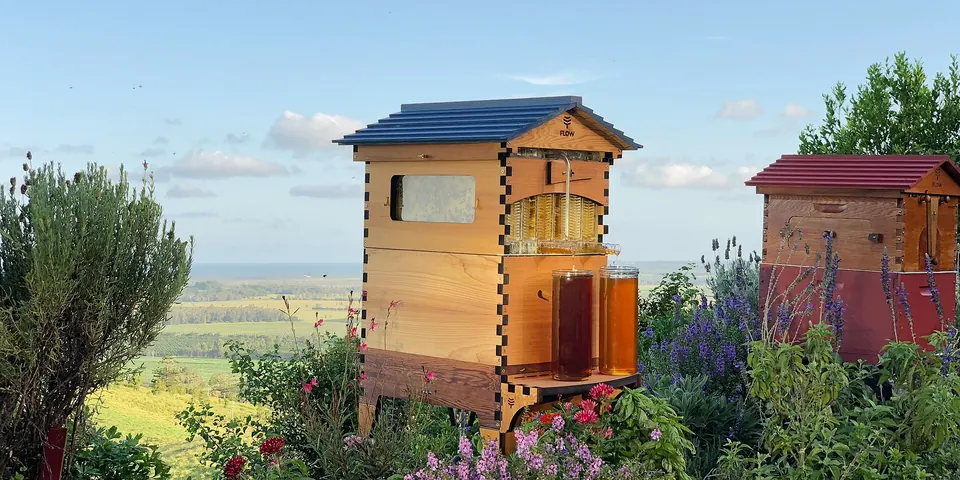
Alternatives worth a look
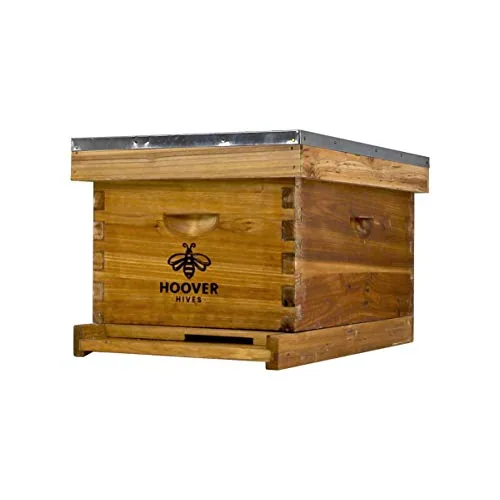
Hoover Hives 8-Frame Deep Hive Kit, Assembled
- Frames
- 8 with foundation
- Boxes
- 1 deep
- Material
- Fir
Best for A lighter assembled first hive
Why consider it: An assembled, wax-coated 8-frame deep, the same box size as the Flow Hive 2 brood box, ready for conventional supers.
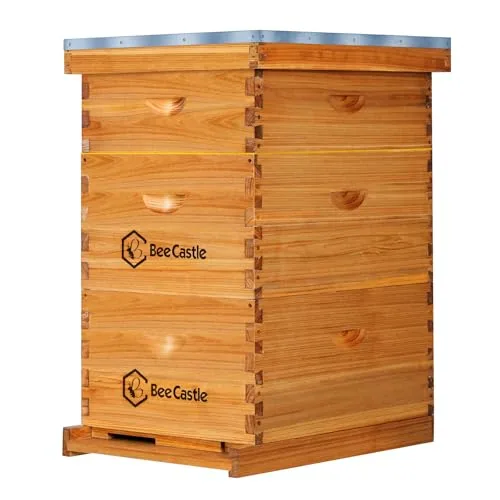
BeeCastle 10-Frame Waxed Langstroth Hive, 2D+1M
- Frames
- 10
- Boxes
- 2 deep, 1 medium
- Material
- Cedar boxes, pine frames
Best for A full-size first hive
Why consider it: A beeswax-coated cedar 10-frame hive with two deeps and a medium, for more room per box.
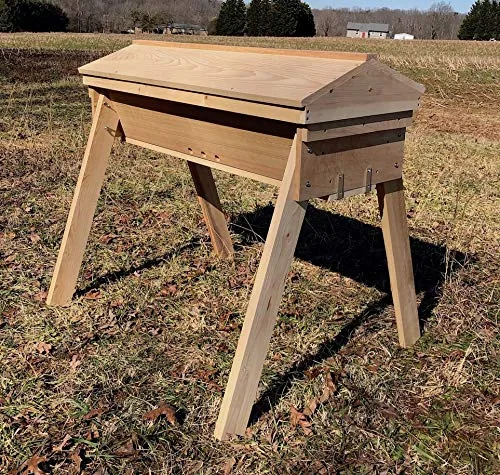
Gold Star Honeybees Top Bar Hive Kit
- Type
- Top bar hive
- Size
- 48 x 48 x 36 in
- Includes
- Bevel-point top bars, glass observation window
Best for Beekeepers who want to avoid lifting
Why consider it: A top bar hive with no boxes to lift and natural comb. Harvest is crush and strain, not a tap.
Built from the official listing, Flow's support pages and forum, and extension and HBHC sources. Hive & Frame keeps no test colonies and did not assemble or harvest from this hive.
Questions
Is the Flow Hive 2 worth it?
How much honey does the Flow Hive 2 produce?
Does the Flow Hive 2 come with bees?
How can you tell a Flow Hive 2 listing is genuine?
Will a Flow Hive 2 super fit an existing Langstroth hive?
Does a Flow Hive still need varroa mite treatment?
Sources
- Flow support: How much honey comes out of a Flow Hive or super
- Flow support: Why choose a genuine Flow Hive
- Flow forum: Flow Hive 2 dimensions (Flow staff reply)
- Flow: hive sizing guide
- USDA NASS, Honey report (March 2026)
- Honey Bee Health Coalition, Tools for Varroa Management, 9th edition (2026)
- EPA: registered pesticide products approved for use against varroa mites
- Penn State Extension: Installing Packaged Bees
- Utah State University Extension: Setting Up and Placing a Hive
- USDA AMS: U.S. Grades for Extracted Honey
- Apiary Inspectors of America