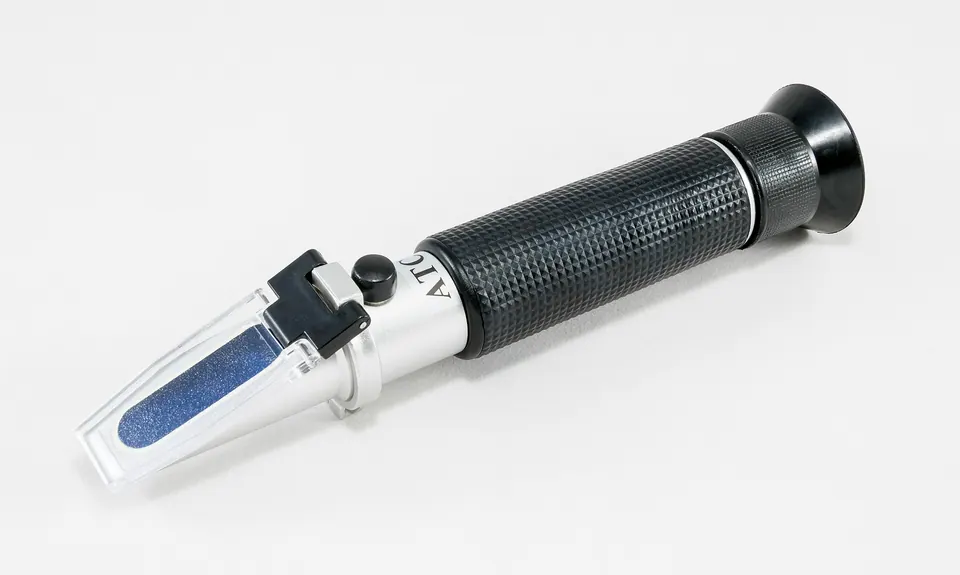
- Best overall: aichose 3-in-1 with a direct honey moisture scale (12 to 27%), 0.5% divisions and ATC.
- Finest moisture scale: TRZ, 10 to 32% water in 0.2% steps, calibrated with an included solution, not water.
- Best digital: Milwaukee MA871, 0 to 85% Brix, ±0.2% Brix, water calibration, but no honey moisture scale.
- USDA grade standards: grades A and B need at least 81.4% soluble solids, which the standard's own table equates to 18.6% moisture; grade C needs 80.0% (20.0% moisture).
A honey refractometer measures how much light bends as it passes through a drop of honey. Wetter honey bends light less, so the instrument can read water content directly on a honey moisture scale. That matters because honey with too much water can ferment in the jar, and because the USDA grade standards set minimum soluble solids for each grade.
We compared eight refractometers from eight brands by scale (honey moisture, Brix, Baume), range, resolution, automatic temperature compensation (ATC) and calibration method. We also checked the USDA United States Standards for Grades of Extracted Honey directly for the moisture figures below.
Our picks
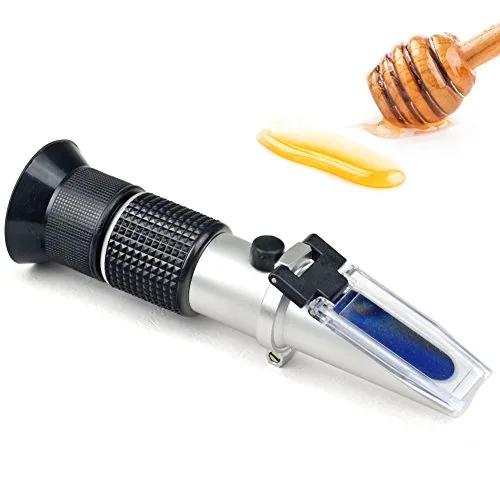
aichose 3-in-1 Honey Refractometer with ATC
- Type
- Analog refractometer, ATC
- Range
- 12-27% moisture, 58-90% Brix, 38-43 Baume
- Resolution
- 0.5% water, 0.5% Brix
The aichose 3-in-1 reads honey moisture (12 to 27%), Brix (58 to 90%) and Baume (38 to 43) on one scale, with divisions of 0.5% water, 0.5% Brix and 0.25 Baume, plus ATC. A dedicated moisture scale means no conversion: put a drop on the prism, look, and read the water percentage. 18.6% falls comfortably inside its range.
Best for: most beekeepers checking honey before bottling
Skip if: you want finer than 0.5% steps
- Direct moisture scale, 12 to 27%
- 0.5% moisture divisions
- ATC
- Analog: reading a line takes practice
- Calibration method not detailed in listing
- Range stops at 27% moisture
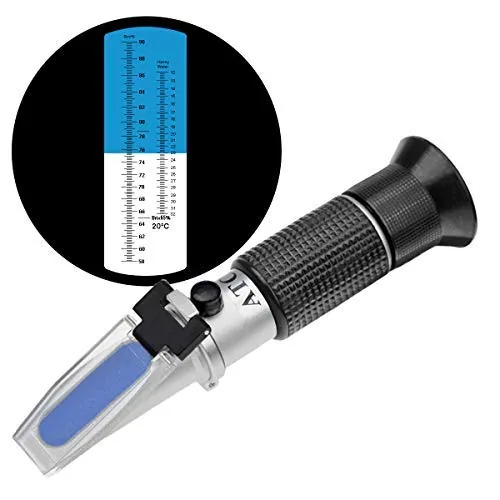
TRZ Honey Refractometer, 10-32% Water, ATC
- Type
- Analog refractometer, ATC
- Range
- 10-32% water, 58-90% Brix
- Resolution
- 0.2%
TRZ's refractometer reads 10 to 32% water and 58 to 90% Brix with 0.2% resolution, the finest moisture steps in this group. It calibrates at 65% Brix with an included calibration solution; the listing warns not to calibrate with water. The adjustable eyepiece and blue-white dividing line help readability.
Best for: honey sellers who want the most precise analog reading
Skip if: you want the simplest calibration
- 0.2% resolution
- 10 to 32% water range
- Calibration solution included
- Don't calibrate with water
- ATC not stated in our data
- Analog reading
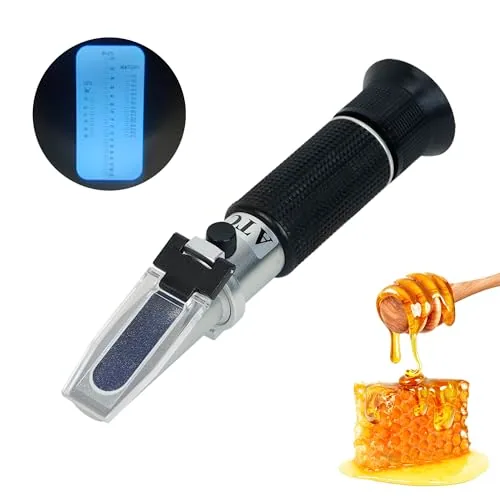
NANBEI Honey Refractometer, Triple Scale, ATC
- Type
- Analog refractometer, ATC
- Range
- 12-27% moisture, 58-90% Brix, 38-43 Baume
- Build
- Copper chrome-plated
NANBEI's triple-scale refractometer reads honey moisture 12 to 27%, Brix 58 to 90% and Baume 38 to 43, with ATC. The listing says that after calibration at 20°C it reads directly between 10 and 30°C. The body is copper with chrome plating, heavier than aluminum, per the maker.
Best for: beekeepers who want a sturdier analog body
Skip if: you want listed resolution
- Moisture scale 12 to 27%
- ATC, 10 to 30°C after 20°C calibration
- Copper chrome-plated body
- Resolution not listed
- Heavier to carry
- Calibration fluid not detailed
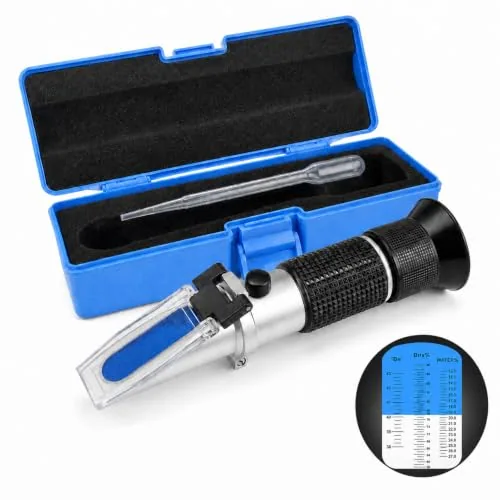
GYE 3-in-1 Honey Refractometer with ATC
- Type
- Analog refractometer, ATC
- Range
- 12-27% moisture, 58-90% Brix, 38-43 Baume
- Resolution
- 0.5% moisture, 0.5% Brix
GYE's honey refractometer lists the same ranges as the aichose: moisture 12 to 27%, Brix 58 to 90%, Baume 38 to 43, with 0.5% moisture and Brix divisions, 0.25 Baume, and ATC. Choose between them on availability and seller support.
Best for: a second, matching unit or a backup
Skip if: you already own a 3-in-1
- Moisture scale with 0.5% divisions
- ATC
- Three scales on one view
- Newer brand
- Calibration details thin
- Same 27% ceiling
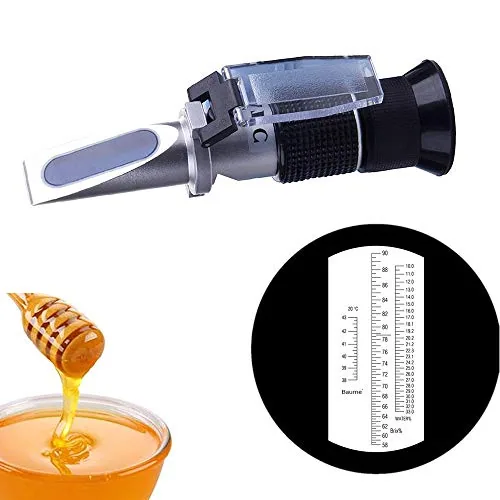
ZffXH 3-in-1 Honey Refractometer with ATC
- Type
- Analog refractometer, ATC
- Range
- 10-33% moisture, 58-90% Brix, 38-43 Baume
- Resolution
- 1% moisture, 1 Brix
ZffXH's 3-in-1 reads moisture 10 to 33% (1% steps), Brix 58 to 90% (1 Brix steps) and Baume 38 to 43 (0.5 steps), with ATC. The listing says to calibrate with extra virgin olive oil or a honey of known moisture, not pure water. The wider range helps with very wet nectar-heavy frames.
Best for: checking wet honey or nectar-heavy frames
Skip if: you need fine resolution near 18%
- Widest moisture range here (10 to 33%)
- ATC
- Clear calibration guidance
- 1% moisture steps are coarse
- Needs oil or known honey to calibrate
- Analog reading
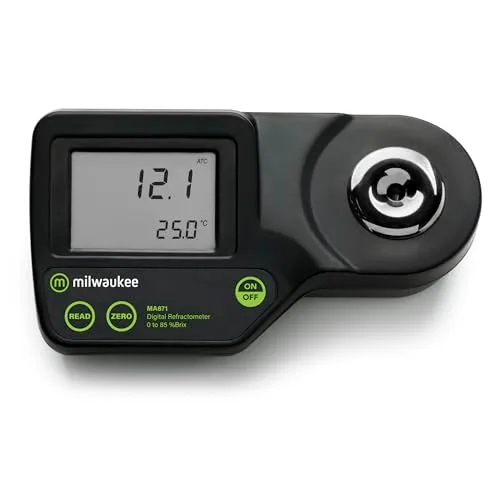
Milwaukee MA871 Digital Brix Refractometer, 0-85%
- Type
- Digital refractometer, ATC
- Range
- 0-85% Brix
- Resolution
- 0.1% Brix
- Accuracy
- +/-0.2% Brix
Milwaukee's MA871 is a digital Brix refractometer with a 0 to 85% Brix range, 0.1% resolution, ±0.2% Brix accuracy, automatic temperature compensation per the ICUMSA methods, a 1.5-second reading, a sealed flint glass prism and a stainless sample well. It calibrates with distilled or deionized water. It reads Brix only, not honey moisture, so you need a conversion for honey.
Best for: users who want a digital readout and simple water calibration
Skip if: you want to read honey moisture directly
- Digital, ±0.2% Brix
- Water calibration
- 1.5 s readings
- No honey moisture scale
- Range tops out at 85% Brix
- Battery-powered
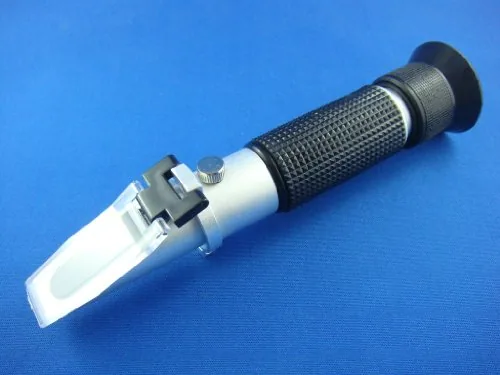
Ade Advanced Optics AO-81150-14 Honey Refractometer
- Type
- Analog refractometer
- Range
- 58-90% Brix
- Resolution
- 1.0%
- Accuracy
- +/-0.5%
Ade Advanced Optics' AO-81150-14 is an analog Brix refractometer for the high-sugar range, 58 to 90% Brix, with 1.0% resolution and ±0.5% accuracy. Like the Milwaukee, it has no moisture scale, so it suits users who already work in Brix.
Best for: users who already think in Brix
Skip if: you want direct moisture readings
- 58 to 90% Brix range
- ±0.5% accuracy listed
- Simple analog
- No moisture scale
- 1% resolution
- ATC not stated
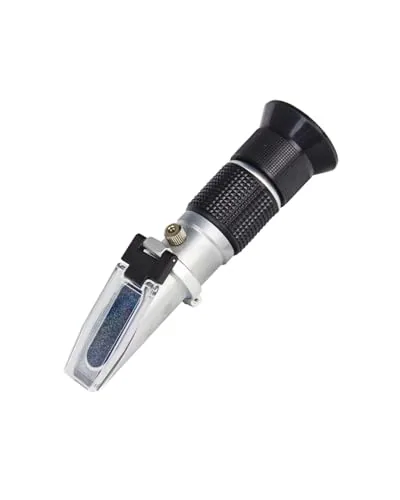
LOHAND 0-90% Brix Refractometer
- Type
- Analog refractometer
- Range
- 0-90% Brix
- Resolution
- 0.5
LOHAND's refractometer reads 0 to 90% Brix with 0.5 resolution, in a chromium and copper body. It covers syrups, juices and honey, but there's no honey moisture scale, so it's better as a general kitchen and orchard tool than a dedicated honey meter.
Best for: beekeepers who also test syrups, fruit or brewing
Skip if: honey moisture is your main use
- 0 to 90% Brix
- 0.5 resolution
- Chromium and copper body
- No moisture scale
- ATC not stated
- General-purpose, not honey-specific
What moisture should honey be? The USDA numbers
The USDA United States Standards for Grades of Extracted Honey (effective May 23, 1985) measure soluble solids with a refractometer at 20°C (68°F). Its Table III pairs each refractive index with percent soluble solids and percent moisture; 81.4% soluble solids corresponds to 18.6% moisture.
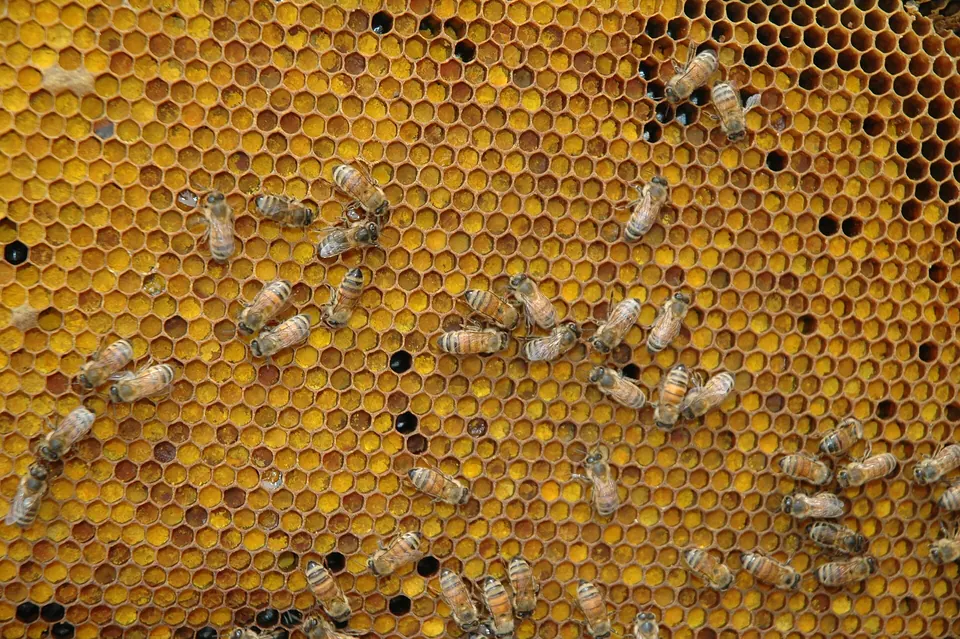
USDA minimum soluble solids by grade
| Grade | Min. soluble solids | Equivalent moisture (Table III) | Min. total score |
|---|---|---|---|
| U.S. Grade A | 81.4% | 18.6% | 90 points |
| U.S. Grade B | 81.4% | 18.6% | 80 points |
| U.S. Grade C | 80.0% | 20.0% | 70 points |
| Substandard | Fails Grade C | — | — |
Source: USDA AMS, U.S. Standards for Grades of Extracted Honey, Tables III to V
These grade standards are voluntary; grade is also scored on flavor, defects and (for filtered honey) clarity. Many beekeepers aim below 18.6% simply to keep honey from fermenting. If you sell, check your state's honey rules as well.
Honey refractometer specs compared
Refractometer scales as listed
| Model | Moisture scale | Brix range | Resolution | ATC |
|---|---|---|---|---|
| aichose 3-in-1 | ✓ 12 to 27% | 58 to 90% | 0.5% water | ✓ |
| TRZ | ✓ 10 to 32% | 58 to 90% | 0.2% | not stated |
| NANBEI triple scale | ✓ 12 to 27% | 58 to 90% | not listed | ✓ |
| GYE 3-in-1 | ✓ 12 to 27% | 58 to 90% | 0.5% moisture | ✓ |
| ZffXH 3-in-1 | ✓ 10 to 33% | 58 to 90% | 1% moisture | ✓ |
| Milwaukee MA871 (digital) | ✗ | 0 to 85% | 0.1% Brix | ✓ |
| Ade AO-81150-14 | ✗ | 58 to 90% | 1.0% | not stated |
| LOHAND | ✗ | 0 to 90% | 0.5 | not stated |
Source: Hive & Frame catalogue (maker listings, November 2026)
Moisture-scale divisions
Smaller steps make it easier to see 18.6% vs 18.0%.
Moisture scale or Brix: which honey refractometer do you need?
Buy a refractometer with a honey moisture scale if moisture is what you care about. Brix-only meters (Milwaukee, Ade, LOHAND) report sugar content and need a conversion table for honey. The USDA table relates refractive index to soluble solids and moisture for honey specifically, and a sucrose Brix reading is not guaranteed to match it exactly.
How to test honey moisture
- Calibrate
Calibrate at room temperature, ideally near 20°C (68°F), with the fluid your model specifies.
- Sample several frames
Take a drop from different frames or from the strained bucket. Moisture varies frame to frame.
- Read
Close the cover plate, wait a few seconds for temperature to even out, then read the moisture line.
- Act on the number
At or below 18.6% you are within the USDA grade A/B limit. Above it, leave frames on the hive longer, or mix with drier honey before bottling.
- Clean the prism
Wipe with a soft damp cloth; don't scratch the glass.
Full walkthrough: honey moisture: refractometers and readings.
Related: how to extract honey and honey labeling rules.
Mistakes to avoid
- Testing only one frame. Sample several.
- Skipping calibration. A new instrument may be off out of the box.
- Reading a Brix meter as moisture. They are different scales.
- Assuming capped means dry. Capped honey is usually ripe, but test before selling.
- Testing after bottling. Test in the bucket, before jars. See best honey bottling buckets and estimate jar counts with the honey yield calculator.
Find refractometers and other harvest tools in the honey harvest category; selling tips on the honey sellers page, and jar options in best honey jars.
For most beekeepers, the aichose 3-in-1 is the easiest buy: a direct honey moisture scale covering the 18.6% USDA grade A/B limit, 0.5% divisions and ATC. Choose the TRZ if you want 0.2% steps, or the Milwaukee MA871 if a digital readout and water calibration matter more than a moisture scale.
We compared refractometer listings by scale type, range, resolution, accuracy where given, ATC and calibration method. We read the USDA AMS grade standard for extracted honey directly to confirm the 81.4% soluble solids and 18.6% moisture figures for grades A and B and the 80.0% / 20.0% figures for grade C. We did not test honey with these instruments.