- This beekeeping glossary defines 132 terms in six groups: the colony, hive equipment, tools and gear, honey and hive products, management, and pests and treatments.
- Many entries link to a full guide, so you can jump from a word to how-to steps.
- Health terms follow the Honey Bee Health Coalition's 9th-edition varroa guide and EPA rules; honey terms follow USDA and FDA documents.
A beekeeping glossary is the fastest way to decode your first beekeeping book, club meeting or inspection with a mentor. Beekeepers use a lot of shorthand: supers, nucs, queenright, bee space, dearth, phoretic. Once the words make sense, the advice does too.
Terms are grouped by topic rather than A to Z, so related words sit together. Development times come from University of Florida extension, mite terms from the Honey Bee Health Coalition, honey terms from USDA and FDA documents.
How to use this beekeeping glossary
The 132 terms are grouped into six topics, from the bees themselves to pests and treatments. Each definition is written for a first- or second-year beekeeper, and many link to a full guide.
Terms in this glossary by topic
Bee development: egg to adult
| Caste | Typical days from egg to adult | Cell type |
|---|---|---|
| Queen | 15–16 | Large peanut-shaped queen cell |
| Worker | 21 | Standard worker cell, flat capping |
| Drone | 24 | Larger cell, domed capping |
Source: UF/IFAS EDIS IN1005, European Honey Bee
Beekeeping terms: bees and the colony
- Apis mellifera: The western honey bee, the species kept in almost every US hive.
- Colony: One queen, thousands of workers and, in the warm season, drones, living together as a single unit. The hive is the box; the colony is the bees.
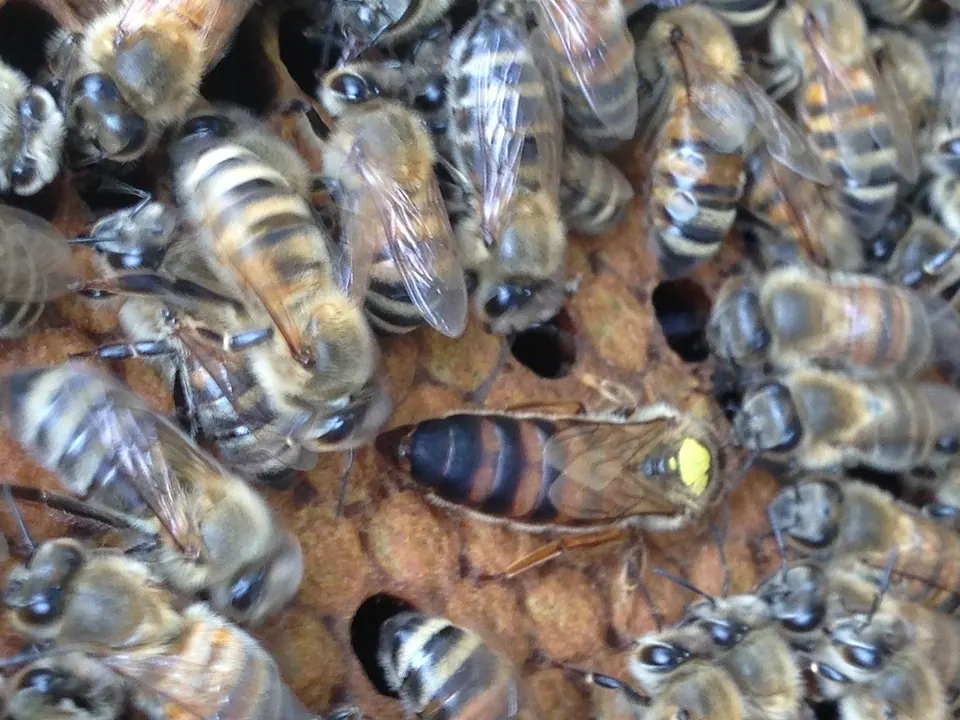
- Queen: The colony's only fully developed female, and normally its only egg layer. Her pheromones hold the colony together. Typical development from egg to adult is 15–16 days.
- Worker: A female bee that does all the colony's work: cleaning, nursing, building comb, guarding and foraging. Typical development takes 21 days.
- Drone: A male bee. Drones have no stinger and do no hive work; their job is to mate with queens from other colonies. Typical development takes 24 days.
- Nurse bee: A young worker that feeds larvae and the queen.
- Forager: An older worker that collects nectar, pollen, water and propolis outside the hive.
- Guard bee: A worker stationed at the entrance that checks incoming bees and defends against robbers and pests.
- Brood: All developing bees in the comb: eggs, larvae and pupae.
- Egg: The first stage of development; a tiny rice-shaped speck standing in the bottom of a cell. Finding eggs tells you a queen was laying within the last few days.
- Larva: The white, C-shaped grub stage that hatches from the egg and is fed by nurse bees.
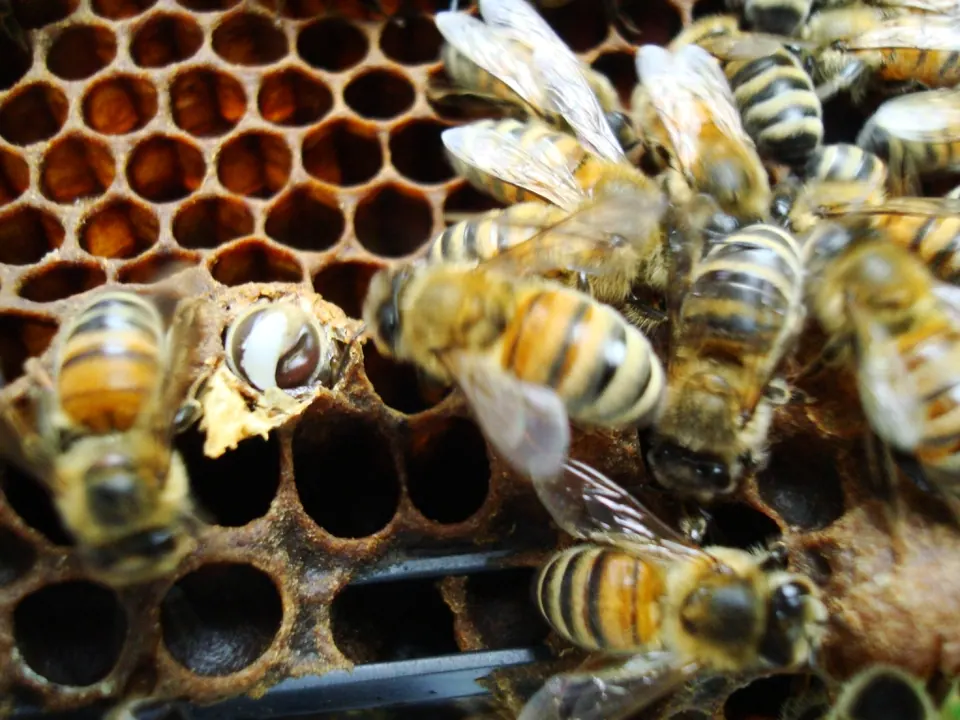
- Pupa: The stage after the larva spins a cocoon inside a capped cell, during which it turns into an adult.
- Capped brood: Cells sealed with a porous wax capping while the pupa develops. Worker brood cappings are flat; drone cappings are domed.
- Brood pattern: How evenly the brood fills a frame. A solid pattern suggests a healthy, laying queen; a spotty one can point to queen, disease or mite problems.
- Brood nest: The central part of the hive where the queen lays and the brood is raised, usually ringed by pollen and then honey.
- Cluster: The tight ball bees form in cold weather to share heat; in winter the cluster moves slowly across the honey stores.
- Queenright: A colony with a healthy, laying queen.
- Queenless: A colony with no queen. Without eggs or young larvae it cannot raise a new one on its own. See hive problems.
- Virgin queen: A newly emerged queen that has not yet mated.
- Mating flight: The flights a virgin queen makes to mate with drones before she starts laying.
- Laying worker: A worker that lays unfertilized eggs after a colony stays queenless too long, producing only drones.
- Drone-laying queen: A queen that lays only unfertilized (drone) eggs, often because she is out of stored sperm or poorly mated.
- Supersedure: When a colony replaces its queen without swarming, usually because she is failing.
- Swarm: The colony's natural way to reproduce: the old queen leaves with a large share of the workers to start a new nest. See how to prevent swarms.
- Absconding: When an entire colony abandons its hive, often after disturbance, pests or lack of food.
- Pheromone: A chemical signal bees use to communicate, from queen pheromone to alarm and orientation scents.
- Alarm pheromone: A scent released when a bee stings or is disturbed that alerts other bees. Smoke helps mask it.
- Nasonov pheromone: An orientation scent workers release from a gland near the tip of the abdomen, often fanning at the entrance, to guide bees home.
Hives and equipment
- Langstroth hive: The standard US hive of stacked boxes with removable hanging frames, based on L. L. Langstroth's design. Comes in 8- and 10-frame widths; see 8-frame vs 10-frame.
- Top bar hive: A long horizontal box where bees build comb down from wooden bars, without full frames. See Langstroth vs top bar.
- Warré hive: A vertical hive of small boxes with top bars, managed by adding boxes underneath.
- Flow Hive: A hive made by Flow whose honey super holds Flow Frames that let honey drain from a tap. Watch for knockoffs: see how to spot a fake Flow Hive.
- Deep (brood box): The tallest standard Langstroth box, usually used for the brood nest.
- Medium: A mid-height box used as a honey super or, by some beekeepers, for everything so all boxes match.
- Shallow: The lowest standard box, used for honey or comb honey; lightest to lift when full.
- Super: Any box added on top of the brood boxes; a honey super is one meant for surplus honey.
- Hive body: A box in the hive, usually meaning a brood box.
- Frame: The removable wooden or plastic rectangle that holds comb.
- Foundation: A sheet of wax or plastic embossed with cell shapes that guides bees to build straight comb. See plastic vs wax foundation.
- Foundationless frame: A frame with only a starter strip or guide, where bees build their own comb.
- Bee space: The gap bees leave open as a walkway, roughly a bee's width. Smaller gaps get filled with propolis and larger ones with burr comb; Langstroth hives are built around it.
- Bottom board: The floor of the hive; it usually forms the entrance.
- Screened bottom board: A bottom board with mesh instead of solid wood, used for ventilation and for counting mites that drop through.
- Inner cover: A flat board under the outer cover with a center hole, giving an insulating air gap and a place for a bee escape or feeder.
- Telescoping cover: An outer lid that overhangs the top box on all sides, usually with a metal top.
- Migratory cover: A flat lid flush with the box sides, so hives can be packed tightly for moving.
- Entrance reducer: A strip that narrows the entrance so a small colony can defend it, or to reduce robbing.
- Mouse guard: A metal strip with small holes over the entrance that keeps mice out in winter while letting bees through.
- Queen excluder: A grid that worker bees can pass through but the larger queen cannot, used to keep brood out of honey supers.
- Nuc box: A small hive, often five frames, used to house a nucleus colony, start splits or catch swarms.
- Swarm trap: A box baited with old comb or lure and hung to attract scout bees from a swarm. See how to catch a swarm.
- Robbing screen: An entrance screen that lets resident bees in and out but confuses robbers.
- Top feeder: A feeder that sits on top of the brood box under the cover, holding syrup bees reach from below.
- Frame feeder: A narrow container that hangs in the box in place of a frame and holds syrup.
- Entrance feeder: A small feeder, often a jar on a base, that slides into the entrance. Easy to check but can invite robbing.
- Candy board: A frame-sized tray of hard sugar placed over the cluster as emergency winter food.
- Bee escape: A one-way device that lets bees leave a super but not return, used to clear supers before harvest.
- Hive stand: A base that raises the hive off damp ground and makes lifting easier.
Tools and protective gear
- Hive tool: A flat steel bar for prying boxes apart and scraping wax and propolis; a J-hook version also lifts frames.
- Smoker: A metal can with bellows that burns fuel to make cool smoke, which calms bees and masks alarm pheromone.
- Smoker fuel: Burlap, cotton, pine needles or pellets burned in a smoker; avoid anything treated with chemicals.
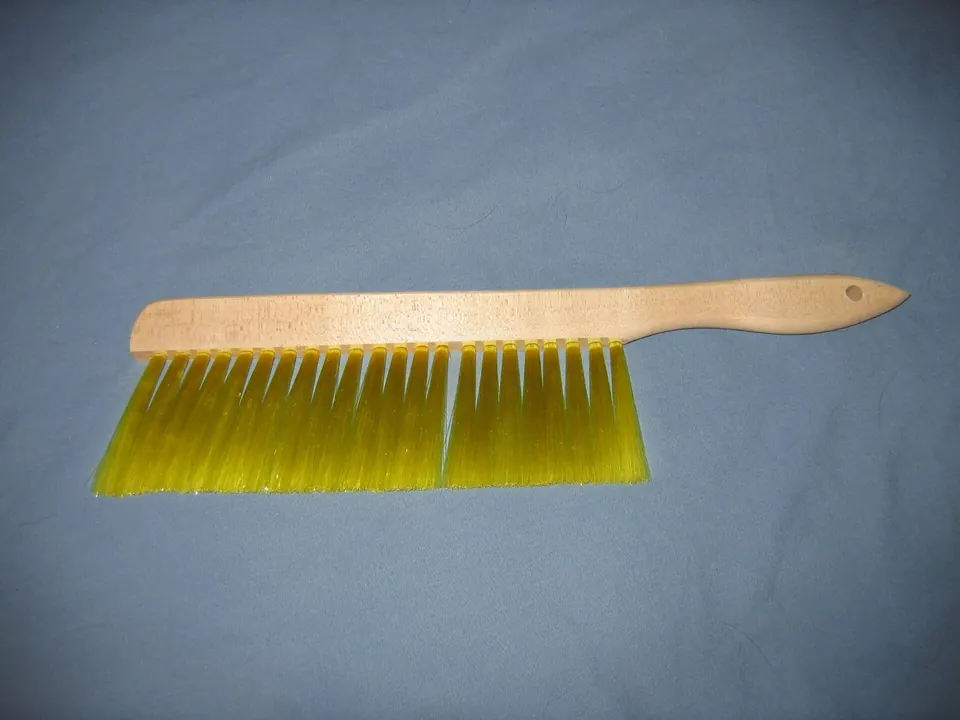
- Bee brush: A soft brush for moving bees off frames gently.
- Frame grip: A clamp for lifting frames out with one hand.
- Veil: Mesh that protects the face and neck; the one piece of gear every beekeeper should wear.
- Bee suit: A full coverall with an attached or zip-on veil; ventilated suits use several layers of mesh.
- Queen catcher: A clip or tube for holding the queen safely while marking or moving her.
- Queen marking: A dot of paint on the queen's thorax that makes her easier to find; many beekeepers use a color for each year.
- Uncapping knife: A blade, cold or electrically heated, used to slice wax cappings off honey frames before extraction.
- Uncapping fork: A comb of fine tines used to lift cappings, handy for low spots the knife misses.
- Extractor: A drum that spins frames so centrifugal force throws honey out of the comb. See radial vs tangential.
- Radial extractor: An extractor that holds frames like wheel spokes, emptying both sides at once.
- Tangential extractor: An extractor that holds frames facing outward, emptying one side at a time; frames are flipped midway.
- Double sieve: A two-layer stainless strainer that sits on a bucket to remove wax bits from honey.
- Honey gate: The valve on an extractor or bottling bucket used to fill jars.
- Refractometer: An optical meter that reads honey's moisture from a single drop. See honey moisture and refractometers.
Honey and hive products
- Nectar: The sugary liquid flowers produce; bees evaporate water from it and add enzymes to make honey.
- Honey flow (nectar flow): A period when major plants are blooming and bees bring in nectar faster than they use it.
- Dearth: A period with little or no nectar coming in; robbing and defensiveness increase.
- Cappings: The wax lids bees put on cells of ripe honey; cut off before extraction and the cleanest source of beeswax.
- Moisture content: The share of water in honey. USDA Grade A extracted honey needs 81.4% soluble solids or more, which is 18.6% moisture or less.
- Extracted honey: Honey separated from the comb by spinning, gravity, straining or other means.
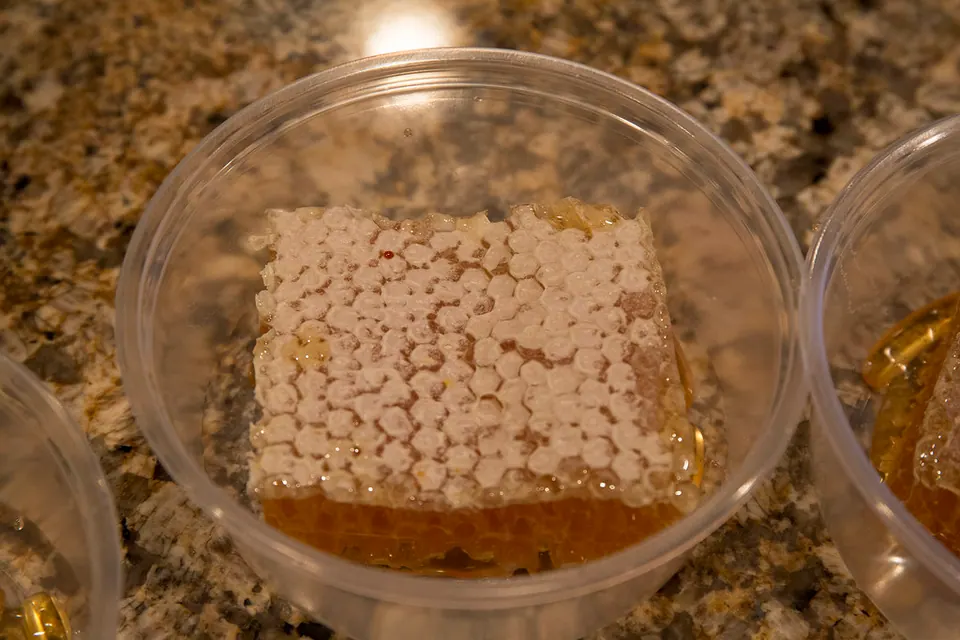
- Comb honey: Honey sold still in the wax comb, cut or in cassettes.
- Crush and strain: Harvesting by crushing comb and letting honey drip through a strainer, with no extractor.
- Creamed honey: Honey crystallized under control to a fine, smooth, spreadable texture; nothing is whipped in.
- Crystallization (granulation): Natural setting of honey into crystals; gentle warming re-liquefies it.
- Raw honey: Honey that has not been heated or filtered heavily. FDA's honey labeling guidance does not define the term; some states do.
- Pollen: Protein-rich grains bees collect from flowers to feed brood.
- Bee bread: Pollen packed into cells and preserved with honey and enzymes; the colony's protein store.
- Royal jelly: A protein-rich secretion nurse bees feed to all young larvae and, throughout, to developing queens.
- Propolis: Sticky plant resin bees collect to seal gaps; the USDA honey standard describes it as a gum ranging from light yellow to dark brown.
- Beeswax: Wax secreted by young workers from glands on their abdomen and used to build comb. See how to render beeswax.
- Burr comb: Extra comb built in the wrong place, such as between boxes; often a sign of too much space.
- Brace comb: Small bits of comb bees build to connect frames to each other or to the box.
- Slumgum: The dark residue left after rendering old comb, mostly cocoons and debris.
Management and the beekeeping year
- Apiary (bee yard): A place where hives are kept.
- Apiarist: A beekeeper. A state apiarist is the official in charge of a state's apiary inspection program; see beekeeping laws by state.
- Inspection: Opening the hive to check brood, stores, the queen and pests. See how to inspect a beehive.
- Package: A screened box of loose bees with a caged queen, sold by weight from bee suppliers in spring. See how to install a package.
- Nuc (nucleus colony): A small working colony on a few frames with a laying queen, brood and stores. See packages vs nucs vs swarms.
- Split: Dividing one colony into two to make increase or prevent swarming.
- Combine: Uniting two colonies into one, often through a sheet of newspaper so they mix slowly.
- Requeen: Replacing a colony's queen with a new one, usually a mated queen from a local supplier.
- Swarm cell: A queen cell along the bottom edges of frames, a sign the colony is preparing to swarm.
- Supersedure cell: A queen cell on the face of the comb raised to replace a failing queen.
- Emergency cell: A queen cell built over a worker larva after the queen is lost suddenly.
- Queen cup: An empty, cup-shaped start of a queen cell; common and not always a sign of swarming.
- Spring buildup: The rapid growth in colony population from late winter into spring.
- Overwintering: Getting a colony through winter with enough bees, food and low mite levels. See how to winterize a beehive.
- Lift test (hefting): Tipping the back of a hive slightly to judge its weight and food stores without opening it.
- Sugar syrup: Sugar dissolved in water and fed to bees; beekeepers often use a thinner 1:1 mix in spring and a thicker 2:1 mix in fall.
- Pollen patty: A pollen or pollen-substitute cake placed over the brood to support brood rearing when natural pollen is short.
Pests, diseases and treatments
- Varroa mite: A parasitic mite that feeds on bees and spreads viruses; the leading threat to honey bee colonies. See the varroa treatment guide.
- Phoretic (dispersal) phase: The stage when varroa mites ride on adult bees instead of reproducing in capped brood; many sources now call it the dispersal phase.
- Alcohol wash: Shaking about 300 bees in alcohol or soapy water to dislodge and count mites. See how to do an alcohol wash.
- Sugar roll: A mite count that coats bees in powdered sugar to dislodge mites; the bees are returned to the hive.
- Mite threshold: The infestation level that calls for control. The HBHC 9th edition uses 1% in the dormant and population-increase phases and 2% at peak and decrease. Try the mite threshold calculator.
- IPM (integrated pest management): Combining monitoring, prevention and, when thresholds are reached, treatment, rather than treating on a calendar.
- EPA-registered: A pesticide product registered by the EPA for a use; for varroa, use only registered products exactly as the label says.
- Oxalic acid: An organic acid used against varroa in registered products such as Api-Bioxal, EZ-OX and VarroxSan; never use wood-bleach or other unregistered oxalic acid.
- Formic acid: An organic acid used in registered varroa products such as Formic Pro; label temperature limits matter.
- Amitraz: The active ingredient in Apivar strips (EPA Reg. No. 87243-1).
- Thymol: A thyme-oil compound used in registered varroa products such as Apiguard.
- Deformed wing virus (DWV): A virus spread by varroa; bees emerge with crumpled wings, a sign of high mite loads.
- American foulbrood (AFB): A highly contagious bacterial brood disease that is reportable in many states. Close the hive, move nothing and contact your state apiarist.
- European foulbrood (EFB): A bacterial brood disease linked to stress; larvae turn yellow to brown and twisted. Confirm with your state apiarist.
- Chalkbrood: A fungal brood disease that turns larvae into chalky white or gray mummies.
- Sacbrood: A viral brood disease in which dead larvae look like fluid-filled sacs.
- Nosema: A microsporidian gut parasite of adult bees; confirming it needs a microscope.
- Small hive beetle: A beetle whose larvae damage comb and make honey ferment, worst in warm, moist regions.
- Wax moth: A moth whose larvae tunnel through stored or weakly guarded comb.
- Robbing: Bees from other colonies stealing honey from a weak hive, most often during a dearth.
- Tropilaelaps: An exotic parasitic mite of honey bee brood that inspectors watch for; report a suspected find to your state apiarist.
Mistakes beginners make with beekeeping words
- Mixing up "hive" (the box) and "colony" (the bees).
- Calling every queen cell a swarm cell; position on the frame tells you more.
- Reading "capped" as "ready": capped brood is not capped honey.
- Assuming "raw" or "local" honey has a federal definition.
- Treating "phoretic" mite counts as the whole story; most mites hide in capped brood.
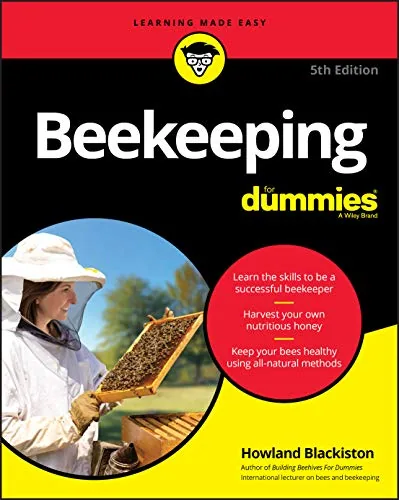
Beekeeping For Dummies
- Format
- Paperback
- Publisher
- Wiley
- Published
- 2020
Best for Absolute beginners
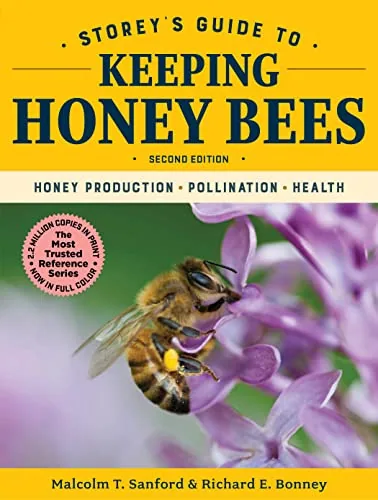
Storey's Guide to Keeping Honey Bees, 2nd Ed.
- Format
- Paperback
- Publisher
- Storey Publishing
- Edition
- 2nd (2018)
Best for Beginners who want depth
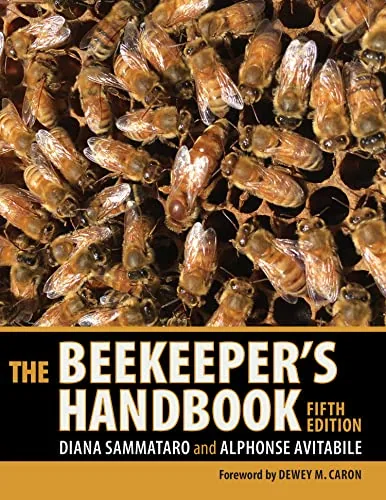
The Beekeeper's Handbook (Sammataro & Avitabile)
- Format
- Paperback
- Publisher
- Comstock (Cornell University Press)
- Edition
- 5th
Best for A reference shelf staple
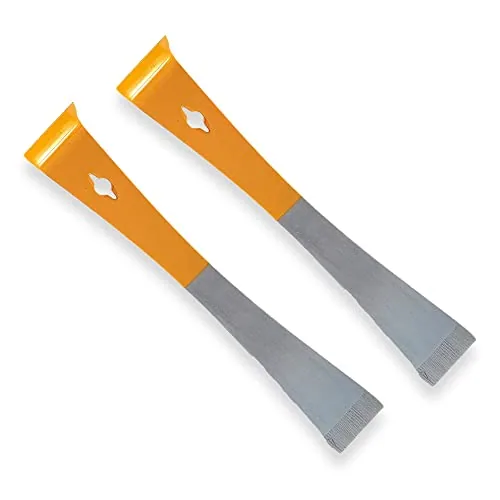
Foxhound Bee Co 304 Stainless Hive Tool, 2 Pack
- Material
- 304 stainless steel
- Count
- 2
- Finish
- Orange painted
Best for Hive tools that are hard to lose
Want the terms in context? Start with how to start beekeeping, browse first hive gear, the hives and kits category and bee health supplies.
Keep this page open during your first season. When a book, mentor or label uses a word you do not know, look it up here, then follow the link to the full guide when you need the how-to.
Definitions are written from standard beekeeping usage and checked against UF/IFAS extension (development times), the Honey Bee Health Coalition 9th edition (mite terms and thresholds), EPA (registered treatments), USDA AMS (honey grades) and FDA (honey labeling).
Questions
What is a super in beekeeping?
What does queenright mean?
What is the difference between a nuc and a package?
What is bee space?
What does phoretic mean in a beekeeping glossary?
What is a dearth?
Sources
- UF/IFAS EDIS: European Honey Bee, Apis mellifera (EENY568/IN1005)
- Honey Bee Health Coalition: Tools for Varroa Management, 9th edition (2026)
- EPA: Registered pesticide products approved for use against varroa mites
- USDA AMS: U.S. Standards for Grades of Extracted Honey
- FDA: Proper Labeling of Honey and Honey Products (2018)
- Texas Apiary Inspection Service: American Foulbrood
- Apiary Inspectors of America: Tropilaelaps